
| PHOTONEWS |
NEWS The 22nd October is the International stuttering awareness day and every year on that date the SAN and stammering/stuttering organizations around the world join together for a common event, which is reproduced throughout the world National Stuttering Awareness Day is a special nationwide commitment…
SAN activities for the YEAR: Running self-help groups for persons who stutter (PWS), and supporting the establishment of new self-help groups. Enhancing public knowledge about stuttering. Arranging conferences and meetings for persons who stutter, speech language therapists and anyone interested in stuttering. Maintaining contact with other stuttering organizations throughout the world. Promoting affordable treatment for people who stutter. Message of SAN: ...To People Who stutter If you are a person who stutters you are not alone. There are many like us and we can help each other. We will show the world that a person who stutters is a normal human being. ...To
the general public ...To employers When you are pondering
employing a person who stutters, evaluate his skills. Don't reject
him because of stuttering. You may lose an excellent worker. The stuttering person you meet, may be your ideal mate! Give it a chance. SAN is a registered charity NGO. A non profit center. ....................................................................................................................................... MR ADEYEMI AKINTUNDE'S PAPER WORKSHOP DELIVERED IN CAMEROON AT THE FIRST AFRICAN STUTTERING CONFERENCE IN OCTOBER 2005. "THE ABSENCE OF MODERN SPEECH THERAPY IN NIGERIA": THE CULTURE PERSPECTIVE Abstract The cultural perspective dominant in Nigeria is that stuttering is a minor handicap when compared to blindness, muteness, paralysis and others. This cultural neglect applies not only to stuttering but also to many psycho neurological disorders. In the country, they are passing things, only to be laughed at and turned into playful philosophical jabs as reflected in this kind of proverb amongst the Yorubas who live in the South-West of the country: " How bliss to watch a mad man in the marketplace, but woe to have him as a child". This is the state of the stutterers in
Nigeria; they are known only for their comic This paper should go down in history as the first attempt from Nigeria at digging the dark situation of stuttering into the light of attention. There has been virtually no organized attempt at putting stutterers in focus in Nigeria. This is despite the fact that about 300,000 children under five are affected with stuttering in Nigeria. Around a quarter of these children are at risk of developing a chronic stammer in adult life unless they receive speech and language therapy during the pre school years. Altogether, approximately 150,000 school age children and 600,000 adults in Nigeria stutter. In discussing why there is an absence of modern speech therapy in Nigeria, one should put into consideration, the status of the country as a society where progressive ideas and abundant resources are not yet reflected in the quality of individual lives. Nigerians live in a modern culture where they are so harassed into a struggle for basic survival, so that every facet of human life in the country is shaped to serve necessities and not essence. Take for instance, two pre-pubertal kids who were kidnapped from a town called Ede in South-West, Nigeria but were miraculously saved returned back to school immediately after that harrowing experience. There was no counseling, no effort by anyone either at their homes or at their elementary schools to make sure that they overcame the traumatizing experience of kidnap. In a country where child labour is still very pervasive, such kids might even be on the streets hawking packaged water immediately after being saved from kidnappers. These kids might be predisposed to stammering, because of this experience, yet one must understand the way the social environment operates so as to identify why there is an absence of modern speech therapy.Autistic children in a typical school in Nigeria face a scaring challenge early on in life. They can be labeled morons both by parents, teachers and their peers. They can even been flogged it the teacher gets nauseated by their slowness. Findings among stutterers in Nigeria reveal that at least 1 in 5 of every stutterer went through this kind of treatment. The introduction of formal education system in Nigeria has been characterized by a negative orientation towards grades and degrees. What this has meant is that many aspects of the student’s development are jettisoned. Up till date, there has been virtually no awareness or sensitization to recognize neuropsychological disorders in students at any level of the country’s educational system. Hence, the Nigerian stutterer finds himself in a society only geared towards materialistic manifestation of the human individual and he is as a typical Nigerian dictum goes " All On His Own" When compared with the development of social services or the welfare state in countries of the West, the country Nigeria has very poor ‘people-care’ facilities. The unstable political climate of the country as well as the unequal distribution of resources has left very little room for welfaristic imagination. One of the fallouts of this is not only the absence of modern speech therapy but also calamitously a pension system that delays the pensions of ailing frail elderly citizens. When viewed from this point, one can easily decipher the social climate of the country and subsequently understand why there is an absence of modern speech therapy in the country. At the professional level, speech disorders are not a choice specialization for a career. They are no designated departments at any level of the county’s health education and care institutions for speech and communication disorders. This dire lack of professional attention can also be pinpointed as a reason why there is no modern speech therapy in the country. Perhaps, if the degree and the widespread nature of speech disorders in the country are made more public as the stuttering association of Nigeria is trying to, more professional attention will be faced in this direction. Before now, there has been no articulate effort made by stutterers themselves. Stutterers have at best pined at the hopelessness of their situation while society jeered, went by passively or only made them into comic strips. Although, the country can count a few individuals whom despite their stutter went ahead to make a name for themselves, yet has been no concise attempt from any quarters to highlight the interaction between the individual, stuttering and society. The chorus has started however. From
now, the stutter will no longer be the secretive, demure individual
who considers his stutter before choosing a job As a last word, the inventive capacity of the Nigerian society is very poor. The country and indeed the whole continent have had to adapt and assimilate technology from the West. Perhaps, if the inventive capacity of the country is better than it is, resources and strategies will be found even within the Nigerian environment, which can help the stutterer not pine at this condition but live a life of clear tones and meanings. In summary, the following can be identified as the causes and consequences of the absence of modern speech therapy in Nigeria. CAUSES
.............................................................................................................. |
 speech and not helped with the challenges of their speech condition.
Hence, upon evolving into a modern society, it is no wonder that
even modern educational institutions in Nigeria do not pay any attention
to specific and unique psychological development of individuals
at any stage of their lives. This pattern is what the whole society
follows.
speech and not helped with the challenges of their speech condition.
Hence, upon evolving into a modern society, it is no wonder that
even modern educational institutions in Nigeria do not pay any attention
to specific and unique psychological development of individuals
at any stage of their lives. This pattern is what the whole society
follows.The
President of ISA (Australia, Dr. Mark Irwin, the president of
SCAC-Mr. Joseph Lukong |
|

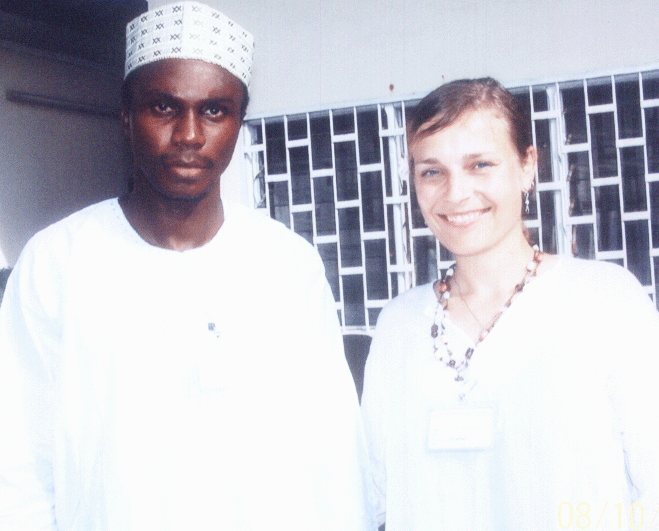 |
Mr
Adeyemi Akintunde (SAN, Nigeria) Susanne Rosenberger (stotterintensivtherapie,
Frankfurt, Germany) |
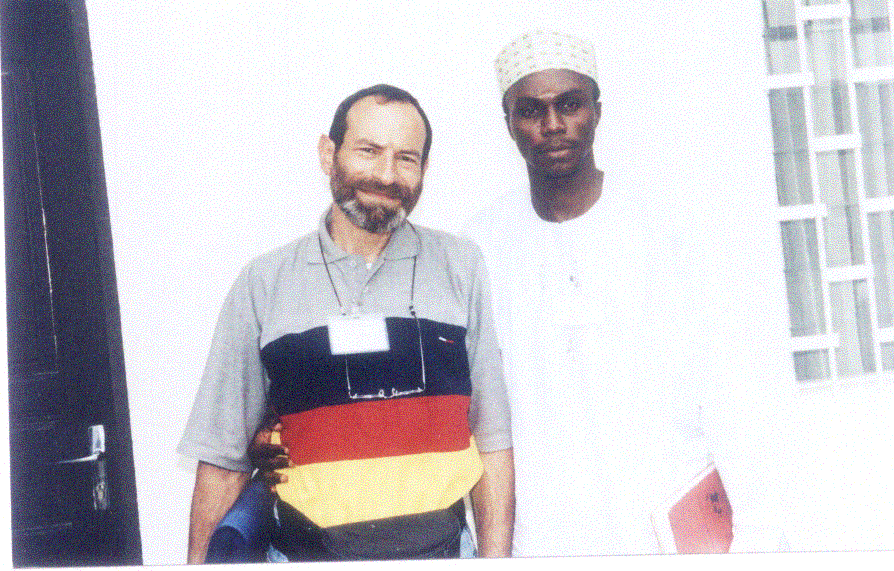 |
| Dr. David Shapiro (Western Carolina University Cullowhee, USA) with the Director of SAN. |
 |
| Dancing time with the President of ‘Association Parole Begaiment France’ Dr Anne Morie . |
 |
| Foreign Delegates at the conference in Douala, Cameroun. |
 |
| Dr. Uppala Radha(Switzerland), Fonyuy Musa & Wife (Cameroun), Joseph Lukong (Cameroun) & SAN director (Nigeria) |
 |
|
| Delegates at the First African Stuttering Conference in Cameroun |
 |
|
| Delegates at the First African Stuttering Conference in Cameroun |
| SAN in schools' campaign (ISAD 2005) |
 |
|
| The director (Adeyemi Akintunde) and the assistant director (Edward D. Abiodun) with the pupils on the ISAD 2005 |
 |
| The director (Adeyemi Akintunde) and the assistant director (Edward D. Abiodun) with the pupils on the ISAD 2005 |
 |
| The director (Adeyemi Akintunde) and the assistant director (Edward D. Abiodun) with the teachers of Hyklass Metropolitan College, Lagos on the ISAD 2005 |
 |
| The director (Adeyemi Akintunde) and the assistant director (Edward D. Abiodun) celebrating ISAD 2005 |
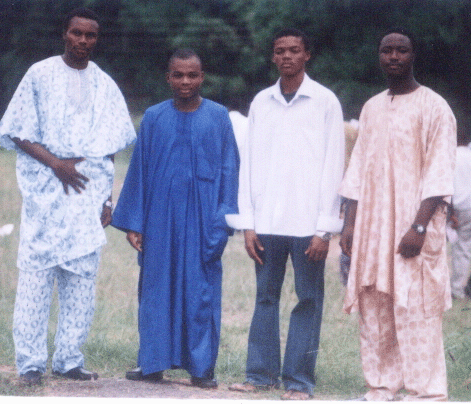 |
| The director (Adeyemi Akintunde) and the students of Bowen University, Iwo, Osun State, Nigeria celebrating ISAD 2005 |
 |